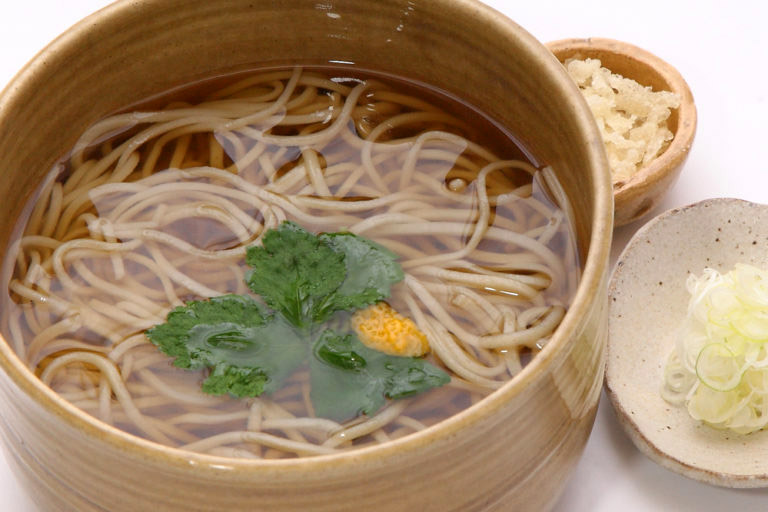
「新そば」の季節ですね!あの独特の清涼感のある香りと、淡い緑がかった色味を目にすると、冬の訪れを感じてワクワクしてしまいます。
先日も、行きつけのお蕎麦屋さんから「新そば」のお誘いを受けていましたのでお呼ばれに行きました。
お店に入った途端、いつもとは違った香りが漂っています。これぞ「新そば」の香りです。
もうこの歳になると、体のあちらこちらがいうことが聞きません。五感も同じです。でも、こうして「新そば」の香りを感じることができてうれしくなります。
一般的に新そばといえば、秋に収穫される「秋そば」(10月〜11月頃)を指しますが、実は夏に収穫される「夏そば」(7月〜8月頃)も新そばと呼ばれます。
「秋そば」は香りが非常に強く、味わいが濃厚。「そば好きの本番」はこちらですね。
「夏そば」は 香りは控えめですが、非常に瑞々しく、喉越しが爽やかです。
打ち立ての新そばが少し緑がかって見えるのは、実が完熟しきる直前の「青実」が混ざった状態で収穫するからです。このクロロフィル(葉緑素)が含まれている状態が、あの爽やかな香りの正体。時間が経つと酸化して茶色くなってしまうため、緑色であることは「鮮度の証」でもあります。
江戸時代、江戸っ子たちは「初物(はつもの)」を食べることを粋としていました。「初物を食べれば寿命が75日延びる」と信じられていたため、新そばが出回るとこぞって蕎麦屋へ駆け込んだそうです。
ちなみに、江戸時代は現代ほど保存技術が良くなかったため、秋の新そばが出る前の時期の蕎麦はかなり味が落ちていたと言われています。だからこそ、新そばの感動は今よりもずっと大きかったのでしょうね。
本当に新そばの香りを堪能したいなら、まずは「何もつけずにそのまま」、次に「水だけ」で食べる「水そば」が通の楽しみ方です。
つゆ(醤油や出汁)の強い味に邪魔されず、蕎麦本来の甘みと、鼻から抜ける野性味のある香りをダイレクトに感じることができます。
これは少し意外な植物学的うんちくなのですが、ソバは米や麦のような「イネ科」ではなく、タデ科の植物です。そのため、分類上は「穀物」ではなく「擬穀類(ぎこくるい)」と呼ばれます。だからこそ、イネ科にはない独特のアミノ酸バランスやルチンといった栄養素が豊富なんですよ。
2011年12月8日投稿の「新そばー朽木の里ー」もご覧ください。
It’s the season of shin-soba (new buckwheat noodles)! Whenever I see that unique refreshing aroma and the faint greenish hue, I can’t help but feel excited for the arrival of winter.
The other day, my favorite soba restaurant invited me to enjoy their shin-soba, so I gladly went. The moment I stepped inside, a fragrance different from usual filled the air. This is the unmistakable scent of shin-soba. At my age, my body doesn’t always do what I want, and the same goes for my senses. But being able to experience the aroma of shin-soba like this makes me truly happy.
Generally speaking, shin-soba refers to “autumn soba,” harvested around October to November. But in fact, “summer soba,” harvested around July to August, is also called shin-soba.
Autumn soba has a very strong fragrance and a rich flavor—it’s the true highlight for soba lovers.
Summer soba, on the other hand, has a milder aroma but is wonderfully fresh, with a refreshing smoothness down the throat.
Freshly made shin-soba often appears slightly greenish because it is harvested when some of the grains are still “green seeds,” just before full ripening. The chlorophyll present at that stage is the source of that refreshing aroma. Over time, it oxidizes and turns brown, so the green color is also proof of freshness.
In the Edo period, townspeople considered eating “first-of-the-season foods” (hatsumono) stylish. It was believed that eating them would extend one’s life by 75 days. So when shin-soba appeared, people would rush to the soba shops. Incidentally, because preservation techniques were not as advanced as they are today, soba available before the autumn harvest was said to taste quite poor. That’s why the excitement over shin-soba back then must have been even greater than it is now.
If you truly want to savor the aroma of shin-soba, the connoisseur’s way is first to eat it plain, with nothing added, and then to try “mizu-soba,” eaten only with water. This way, the strong flavors of dipping sauce (soy sauce or broth) don’t interfere, and you can directly enjoy the natural sweetness of soba and its wild aroma that rises through the nose.
Here’s a slightly surprising botanical fact: soba is not a member of the grass family like rice or wheat, but belongs to the knotweed family. Therefore, it is not classified as a “grain” but as a “pseudo-cereal.” That’s why it is rich in unique nutrients such as a distinctive amino acid balance and rutin, which are not found in true cereals.
Please also take a look at the post from December 8, 2011: “Shin-soba — The Village of Kutsuki.”